
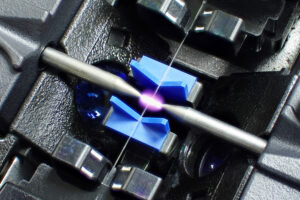
Fiber optic splicing is the process of joining two different fiber optic cables and creating one functioning cable. When done correctly, splicing creates a cable with improved durability and minimal loss.
The two most common methods of fiber splicing are mechanical and fusion. Both perform the same function, but the procedures differ greatly.
Mechanical Splicing vs. Fusion Splicing
There are many factors to consider when choosing which type of fiber splicing to perform. One is simpler, but the other is more precise. Read on to learn the details.
Mechanical Splicing
A mechanical splice aligns two or more cleaved fiber tips and keeps the fibers together with an assembly, usually a plastic snap-type cover. Mechanical splicing takes much less time and effort, using no power supplies and very few tools. However, a mechanical splice is often considered temporary and can cause an insertion loss of about 0.3 dB, meaning light will pass through a little less efficiently than before.
Fusion Splicing
Fusion splicing is the most used method of fiber optic splicing and the main one we will discuss. Rather than using a cover to align the cables, this method involves heating and melting the ends together. This creates a much more durable connection that can reduce loss to 0.02 dB. Between increased durability and improved performance, technicians usually opt to use a fusion splicer when possible.
Fusion splicing is also the most reliable method for single-mode fibers. Different from multimode fibers, single-mode fibers have a thin core that transmits signals without touching the fiber’s edges. Since fusion splicing won’t alter the fiber’s structure, it is recommended for long-term fixes.
How Does Fusion Splicing Work?
Using cameras to align the two fiber ends and clean them of dust or dirt, a fusion splicer provides heat from an electrical arc to weld the ends together, then further tests the integrity of the weld by giving the fiber a tug.